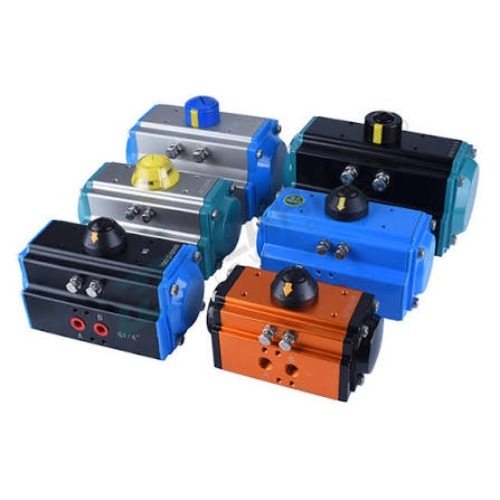
Pneumatic Actuator Price & Specifications
Voltage Not applicable (pneumatic powered)
Valve Type For ball, butterfly, and plug valves
Valve Size Compatible with valves from DN15 to DN200 and above
Type Rack and pinion pneumatic actuator
Temperature -20C to 80C (standard); high/low temp options available
Structure Aluminum alloy actuator body, hard anodized
Sealing NBR or Viton O-rings
Pressure 2.5 to 8 bar (36-116 psi)
Power Pneumatic (compressed air)
Port Size Multiple sizes (commonly 1/4 to 1/2 NPT)
Pin Double rack and pinion system
Media Compressed air, dry and filtered, Compressed air, dry and filtered
Material Anodized aluminum, stainless steel (options)
Features ISO 5211 mounting, visual position indicator, corrosion-resistant finish
Disc Not applicable (actuator component)
Control System Manual or automated (using solenoid, positioner, limit switch box)
Connection Type NAMUR and ISO 5211 mounting interface
Application Automatic control of valves in various industrial processes
About Pneumatic Actuator Detail
Reserve your supreme Pneumatic Actuator today and find the unbeatable price for this highly sought-after automation solution. Delivering redoubtable performance with double-acting and spring return operation modes, these actuators provide torque outputs from 10 Nm up to 2000 Nm depending on the model. Enjoy ISO 5211 direct mounting, durable anodized aluminum housing, various end cap color identifications, and pre-lubrication for a lifetime of reliable use. Designed for cycle life exceeding 1,000,000 cycles, low operational noise, and optional explosion-proof specifications-ideal for industrial applications requiring seamless automatic control of ball, butterfly, and plug valves.
Applications, Features & Special Advantages
Beyond standard valve automation, this Pneumatic Actuator excels in energy, chemical, water treatment, and pharmaceutical industries. Special features include visual position indication, corrosion-resistant finish, multiple color-coded end caps for model identification, and compatibility with both manual and automated controls. Its robust aluminum alloy construction, double rack and pinion system, and ISO 5211/NAMUR interfaces guarantee utmost flexibility, while high or low-temperature variants address even the most challenging environments.
Domestic Market Reach, Sample Policy & Packaging
The Pneumatic Actuator is available throughout India, supported by strong logistics and efficient transportation for rapid delivery. Sample policies ensure customers can review performance before making a full outlay, supporting confident purchasing decisions. Packaging details prioritize product integrity and safe handling during shipment, offering customized solutions for distributors, suppliers, and traders. Comprehensive logistics management and thorough documentation streamline the process from order to installation.
FAQ's of Pneumatic Actuator:
Q: How does the double acting and spring return operation mode benefit the user?
A: The double acting and spring return options allow users to choose between bi-directional control or automatic return to a default position, enhancing flexibility for different valve automation requirements.
Q: What types of valves are compatible with this pneumatic actuator?
A: This actuator is suitable for use with ball valves, butterfly valves, and plug valves, covering a wide range of industrial process control needs.
Q: Where can I use this pneumatic actuator within industrial processes?
A: It's ideal for industries such as oil and gas, water treatment, pharmaceuticals, and general manufacturing where automatic and reliable valve control is needed.
Q: What is involved in the installation process of the actuator?
A: The actuator features an ISO 5211 interface for direct and secure mounting to compatible valves, with NAMUR options for accessories, making installation straightforward for both manual and automated systems.
Q: When should I consider high-temperature or low-temperature variants?
A: Select high- or low-temperature models if your application operates outside the standard -20C to 80C range to ensure reliable performance in extreme conditions.

 GST No.33ABNFA8308B1ZR


 Our Products